NVR hardware is the problem. Okiff Reflex is the software fix.
Okiff Reflex replaces proprietary NVR recorders with a software-defined Router Agent that runs on any standard x86 or ARM appliance you already own — or any commodity server you choose to deploy. Every camera you have works from day one. No hardware lock-in. No rip-and-replace project.
100%
RTSP / ONVIF universal camera compatibility
Zero
Hardware changes required at the camera level
Any CPU
x86 or ARM appliance — commodity or industrial
Why proprietary NVRs fail modern security operations
The NVR model was designed for a world where cameras recorded locally and footage was retrieved manually. It was never engineered for real-time AI inference, multi-site orchestration, or software-defined resilience.
 → Single point of failure. One NVR per site means one hardware failure equals total site blindness. No redundancy. No automatic failover. Physical maintenance required before the site is operational again.
 → Vendor captivity. Proprietary NVR hardware locks operators into a manufacturer's roadmap, pricing, and support lifecycle. Expanding a site means buying from the same vendor — or facing compatibility debt.
 → AI integration failure. Legacy NVRs cannot run multimodal inference models. Plugging an analytics layer on top adds latency, adds cost, and adds another vendor dependency. The architecture is structurally incompatible with real-time intelligence.
 → Scale ceiling. Managing 50 NVRs across 50 sites means 50 separate hardware systems to monitor, update, and replace. There is no unified operational plane.
Okiff Reflex eliminates all four constraints — not by building a better NVR, but by eliminating the NVR model entirely.
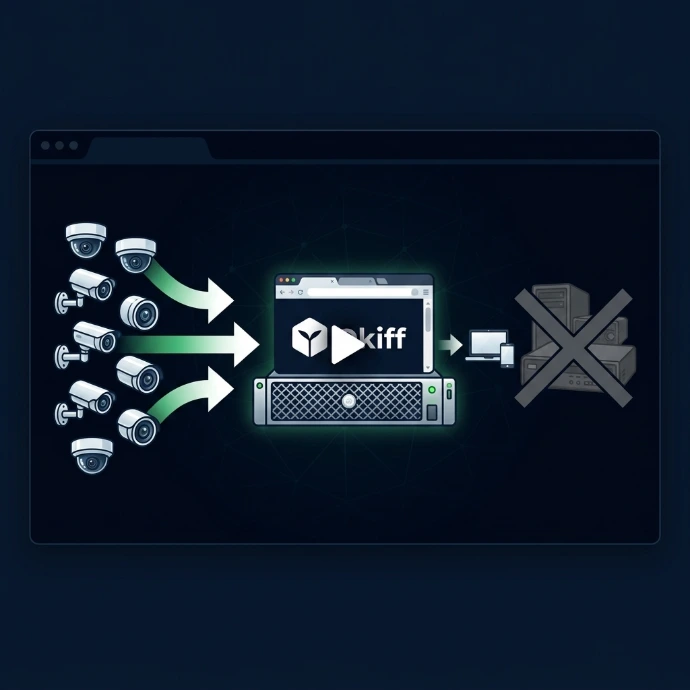
 IP Cameras
Any brand, RTSP/ONVIF

 Okiff Router Agent
Software-defined aggregation layer; runs on standard hardware
 Edge/Local Server
AI inference, storage, rules, failover — local
 Unified Dashboard
All sites, one pane, role-based access
How Okiff Reflex replaces the NVR — architecturally
 — The Router Agent (replaces the NVR): The Okiff Reflex Router Agent is a software module deployed via SDK on any connected network device or edge appliance at the camera site. It receives all camera streams via RTSP, ONVIF, or supported vendor SDKs — regardless of manufacturer or codec (H.264, H.265, AV1, and legacy formats). The Router Agent aggregates, normalizes, and forwards these streams to the Okiff Reflex server. No NVR hardware. No camera reconfiguration. No proprietary cable runs.
 — The Edge/Local Server (the intelligence node): The Okiff Reflex server runs as a containerized stack on any standard x86 or ARM server within your facility — a commodity rack server, a compact edge appliance, a ruggedized industrial box, or existing infrastructure repurposed from decommissioned NVR hardware. Docker and Kubernetes-native deployment means the stack is portable across any compliant hardware. The server runs the full VMS engine, AI inference, storage management, and rules engine locally — no cloud dependency.
 — Zero-Touch Provisioning: Once powered on and network-connected, an Okiff Reflex deployment node authenticates cryptographically with the platform and downloads its configuration automatically. No manual software installation. No on-site DevOps expertise required. The site is operational from connection.
What hardware Okiff Reflex runs on
 Hardware compatibility table
Category | Examples | Notes |
Commodity rack servers | Dell PowerEdge, HPE ProLiant, Supermicro | Standard 1U/2U configurations; optimal for multi-site edge nodes |
Compact edge appliances | Intel NUC Pro, ASUS NUC, Minisforum | Low-power, fanless options for space-constrained deployments |
Industrial edge boxes | Advantech, Kontron, Lanner | Ruggedized for factory, transport, and outdoor environments |
ARM-based compute | NVIDIA Jetson, Raspberry Pi (Compute Module) | For ultra-compact, low-power edge deployments |
Repurposed NVR hardware | Any NVR server with x86 CPU | Existing NVR servers can run Okiff Reflex software — eliminating the hardware cost entirely |
GPU acceleration: AI inference models benefit from GPU acceleration. Okiff Reflex supports NVIDIA GPU configurations — from compact RTX series for edge deployments to industrial-grade configurations for high-camera-density SOC environments. CPU-only deployments are supported for lighter detection workloads.
Camera compatibility table
Protocol | Support |
RTSP | ✅ Universal — all brands |
ONVIF | ✅ Universal — all compliant devices |
H.264 / H.265 / AV1 | ✅ All codecs supported |
Vendor SDKs | ✅ Via Router Agent SDK integration |
PTZ cameras | ✅ Full pan/tilt/zoom control |
Auto-discovery | ✅ Automatic on network connection |
What software-defined hardware really means for your operations

OTA updates
Platform software, AI models, and security patches deploy over-the-air to every hardware node remotely. No on-site engineer required for updates.

HA Failover
High Availability failover is built into the deployment model. If a primary node fails, secondary nodes maintain continuous recording and AI detection without operator intervention.

Zero-Touch Provisioning
New hardware nodes connect, authenticate cryptographically, and receive their full configuration automatically. Adding a new site does not require on-site IT support.

No Vendor Lock-in
The Okiff Reflex stack is hardware-neutral. Replace, upgrade, or scale hardware on your own procurement cycle — no manufacturer dependency, no licensing transfer fees.

Multi-Protocol Unification
A single Router Agent instance handles every camera brand and protocol on the network — aggregated into one normalized feed. No multi-vendor NVR fleet to manage.

Sovereignty by Architecture
All camera data is processed on the hardware you control, within your physical perimeter. The software-defined model does not introduce external cloud processing at any layer.
Hardware-agnostic deployment in real environments

Security Integrator / VAR
An integrator deploying a new multi-building commercial complex quotes Okiff Reflex on commodity 1U rack servers already specified for the building's IT infrastructure. No NVR budget line required. The existing IP camera specification remains unchanged. Hardware cost reduced by 40% versus a traditional NVR-per-building approach.
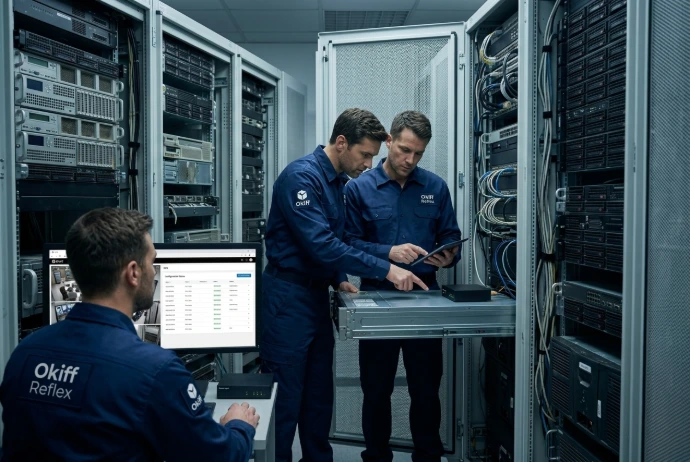
Government Facility Upgrade
A government facility replaces a 12-site NVR estate using existing server hardware from decommissioned systems. The Router Agent is deployed on-site. OTA configuration brings each site online within hours. The entire migration is completed without procuring a single piece of new hardware.
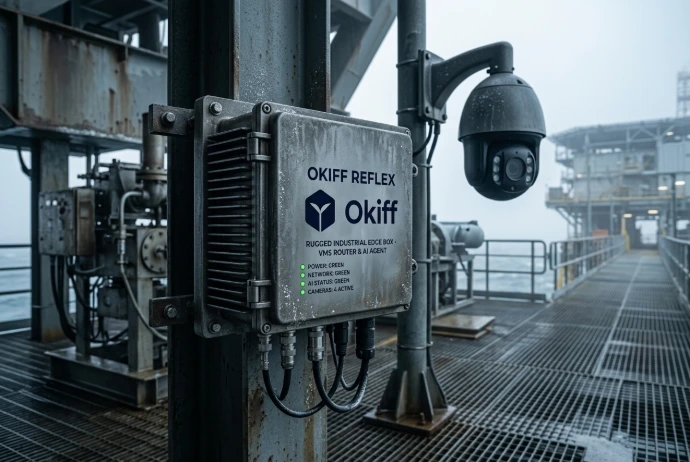
Industrial / Remote Site
An offshore energy operator deploys Okiff Reflex on ruggedized industrial edge boxes rated for vibration, temperature, and salt exposure. The Router Agent aggregates cameras via RTSP. AI inference runs locally at sub-10ms. The site operates fully autonomously during satellite connectivity drops — with no gap in detection or recording.
FAQ
Can Okiff Reflex replace an NVR without changing cameras?
Yes. Okiff Reflex's Router Agent connects to any existing IP camera via RTSP or ONVIF — the two universal protocols supported by virtually all IP cameras manufactured in the last 15 years. No camera hardware is replaced. No recabling is required. The Router Agent creates a software bridge between your existing camera estate and the Okiff Reflex platform.
What type of server hardware does Okiff Reflex require?
Okiff Reflex runs on standard x86 or ARM servers — commodity rack servers, compact edge appliances, or ruggedized industrial hardware. There is no proprietary Okiff Reflex appliance. You choose and procure hardware independently, on your own terms and budget. GPU acceleration is supported for AI inference workloads.
How is Okiff Reflex installed on a new hardware node?
Okiff Reflex uses Zero-Touch Provisioning. Once a new hardware node is powered on and connected to the network, it authenticates cryptographically with the platform and downloads its full configuration automatically. No on-site DevOps expertise is required. The site is operational from the moment of network connection.
What happens if the Okiff Reflex server hardware fails?
Okiff Reflex includes High Availability (HA) failover built into its deployment model. If a primary node fails, secondary nodes automatically maintain continuous recording and AI detection without manual intervention. The failover architecture eliminates the single point of failure that defines legacy NVR deployments.
Can existing NVR server hardware be repurposed to run Okiff Reflex?
Yes. Any decommissioned NVR server with a standard x86 processor can be repurposed to run the Okiff Reflex software stack. This allows organisations replacing NVR systems to eliminate hardware procurement costs while migrating to a software-defined VMS model.
Replace your NVR estate — without replacing your cameras.
A Reflex infrastructure specialist will scope a hardware-agnostic migration plan for your camera footprint and site configuration.