Telecom Infrastructure VMS
Sovereign AI Surveillance for 5G and Data Centers
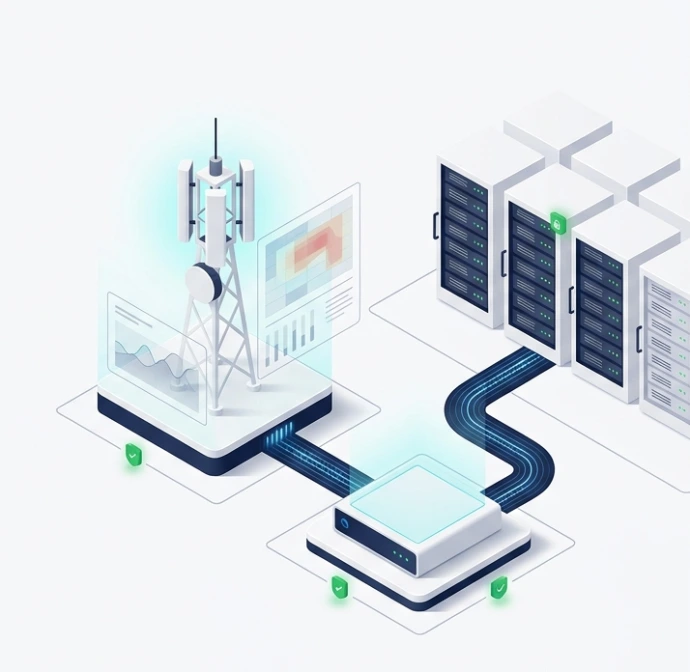
Your infrastructure carries the data of millions. The video management system protecting it must meet the same standard: edge-native, sovereign, and operationally resilient without exception. Okiff Reflex deploys on existing carrier hardware — transforming 5G PoPs and data center premises into intelligent, self-contained security zones.
< 10ms
AI detection latency at the edge
0 bytes
Raw footage transmitted externally
100%
Offline operational continuity
Why standard cloud VMS fails telecom and data center environments
The very infrastructure that enables cloud-based surveillance for others cannot safely rely on it. Telecoms and data centers face a paradox: as operators of sovereign-grade physical infrastructure, they are uniquely exposed to the compliance failures of cloud-dependent security systems.
 → Jurisdictional conflict. A US-headquartered cloud VMS provider is subject to the CLOUD Act — meaning your data center's footage could be accessed by foreign authorities, regardless of where your servers sit. For carriers operating in regulated markets, this is a disqualifying architecture.
 → Latency incompatibility. Security incidents in data centers and network facilities unfold in seconds. A fire event, an unauthorized physical access attempt, or intrusion into a restricted cage requires sub-second AI detection — not a cloud round-trip measured in seconds.
 → Connectivity irony. A surveillance system that depends on WAN connectivity to function is exactly the wrong architecture for the infrastructure that carries WAN connectivity for others. During network events — precisely when physical security risk peaks — a cloud VMS goes dark.
 → Scale without sovereignty. Managing hundreds of PoP sites, exchange points, and co-location facilities demands a unified platform that does not aggregate raw footage centrally or expose it to a third-party cloud.
Okiff Reflex: the VMS architecture built for carrier-grade environments
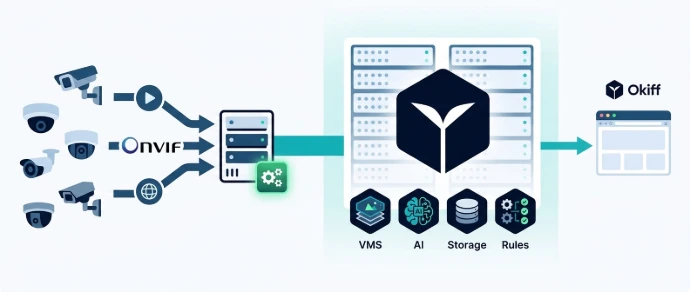
 Deploy at the PoP or data hall
The Reflex Router Agent installs on any existing edge device at the site. It aggregates all IP camera streams — RTSP, ONVIF, legacy formats — without hardware replacement. A standard server hosts the full Okiff Reflex stack: VMS engine, AI inference, storage, and rules engine.
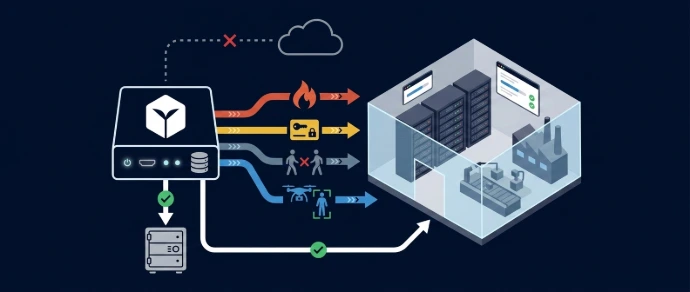
 AI inference runs locally
Fire & smoke, unauthorized access, tailgating, and object detection all execute on-site in under 10ms. No frame data leaves the physical boundary. No cloud API is called at any point in the detection pipeline.
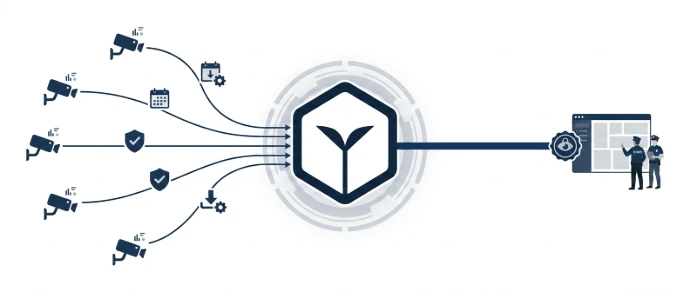
 Fleet management without data exposure
Structured event metadata, node health telemetry, and OTA update delivery flow through an encrypted outbound tunnel to a central dashboard. Your physical security team sees everything. Your footage stays sovereign.
What Okiff Reflex delivers for carrier and data center environments

Restricted cage & zone monitoring
Smart Zone AI detects any unauthorized presence in server halls, power rooms, or cross-connects — in real time.

Fire & smoke detection
AI-powered thermal and visual fire detection triggers in under 10ms — before conventional heat sensors activate.

Tailgating & forced entry detection
Access Control Agent integration flags unauthorized physical access at every controlled entry point.

Cross-zone tracking (MTMC)
Tracks individuals across multiple cameras and zones within a facility — maintaining identity continuity through the entire site.

LPR / ANPR for delivery & vehicle management
Automated plate recognition at loading docks and vehicle access points — no manual log required.

AI video description & natural language search
Locate any footage event across any camera with a plain-language query — without manual scrubbing.

Face recognition
AI-powered identity verification at access-controlled entry points.
Offline operation
Full AI detection and recording continues without internet connectivity — essential for network event scenarios.

OTA fleet management
All software, AI model, and security updates deploy remotely to every site node without on-site engineering.
Your physical security stack, unified
Okiff Reflex natively integrates the full range of physical security and environmental IoT devices typical in carrier and data center environments — via the Router Agent, without middleware:
 Access control
Pull/push events from access controllers via OSDP / Wiegand / vendor SDKs → real-time alerts on badge denial, forced door, or tailgate events.
 Environmental sensors
LoRa / Zigbee / BLE 5.0 sensors for temperature, humidity, and water leak detection — critical for server hall integrity.
 Vehicle management
OBD / BLE / WIFI integration for delivery vehicle tracking and dock scheduling at large facilities.
 Audio monitoring
SIP / TOA protocol support for one-way audio stream monitoring at access points
 POS & visitor management terminals
Vendor SDK integration for reception and visitor management system event correlation.
Use Cases

Tier III Data Center (Multi-Tenant Co-Location)
A co-location operator manages 14 halls across two buildings. Okiff Reflex deploys on existing edge hardware per hall. Smart Zone AI monitors each customer cage — alerting immediately on any unauthorized presence. Cross-zone tracking identifies individuals moving between halls without authorization. Every access event and AI detection is logged with chain-of-custody documentation ready for tenant SLA reporting.

National 5G PoP Fleet
A tier-1 operator manages 340 5G points of presence. Each PoP runs a compact Okiff Reflex edge node. AI detection operates fully offline — disconnected PoPs maintain autonomous surveillance. A centralized operations dashboard surfaces fleet-wide health and security telemetry from structured metadata only, without footage egress. OTA updates deploy to all 340 nodes simultaneously from one management action.
Internet Exchange Point (IXP)
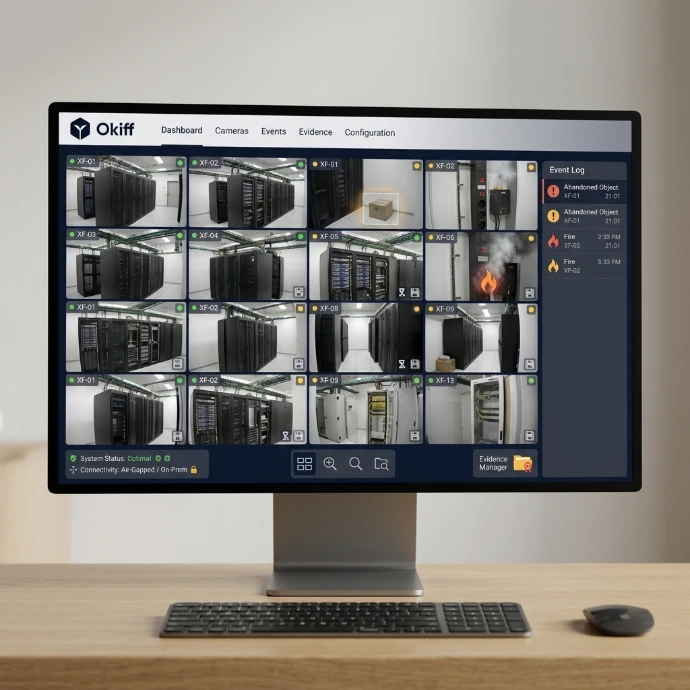
An IXP operator requires continuous monitoring of cross-connect rooms with zero data sovereignty risk. Okiff Reflex runs air-gapped on on-premise hardware. Abandoned object detection and fire/smoke AI run 24/7. Evidence Manager generates tamper-evident footage exports for any physical security incident, compliant with audit requirements for IXP governance frameworks.
FAQ
Can Okiff Reflex operate without internet connectivity at remote PoP sites?
Yes. Okiff Reflex is designed for full offline autonomy. AI detection, footage recording, local alerting, and Rules & Events execution continue without internet connectivity. When connectivity is restored, structured event metadata synchronizes to the central management dashboard automatically.
Does Okiff Reflex require dedicated hardware at each PoP?
No. The Reflex Router Agent deploys on any existing edge device or network appliance already present at the site. A standard commodity server hosts the VMS stack. No proprietary Okiff hardware is required and no cameras need to be replaced.
How does Okiff Reflex protect footage from CLOUD Act exposure?
All footage is processed and stored on hardware within your own physical infrastructure. No raw video data traverses the outbound cloud connector — only structured JSON event metadata. The architecture makes CLOUD Act exposure technically impossible, not just contractually promised.
Can Okiff Reflex manage hundreds of PoP nodes from a single interface?
Yes. Okiff Reflex scales to hundreds of thousands of cameras across unlimited sites. Fleet health, AI alert telemetry, and OTA management are accessible from a single unified dashboard with per-site footage sovereignty preserved at every node.
What physical security IoT systems does Okiff Reflex integrate with in data center environments?
Okiff Reflex integrates with access control via OSDP and vendor SDKs, environmental sensors via LoRa / Zigbee / BLE 5.0, vehicles via OBD / BLE / WIFI, and one-way audio monitoring via SIP and TOA protocols — all aggregated into the unified dashboard without middleware.
The infrastructure you protect deserves the same sovereignty you provide your clients.
Join us and make your company a better place.